

/ News, Research, Info / Rémy Pawlak
New paper in Chem. Eur. J.!
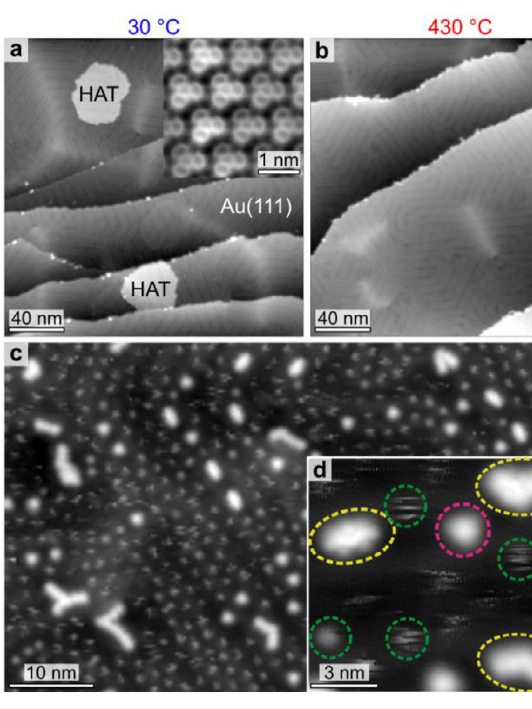
On-surface synthesis (OSS) offers unique opportunities for fabricating carbon-based nanostructures that are unattainable by conventional wet-chemical synthesis. Despite OSS being extremely successful, the use of coadsorbates to promote reactions remains largely unexplored. In this study, we investigate the role of sodium chloride (NaCl) in promoting the Scholl reaction (oxidative aryl–aryl coupling) of hexaazatriphenylene (HAT) molecules on Au(111), leading to the growth of conjugated azaacene oligomers. Using scanning tunneling microscopy (STM), synchrotron-based X-ray photoelectron spectroscopy (XPS), and density functional theory (DFT) calculations, we shed light on the reaction mechanism and the intermediates involved. Upon codeposition on Au(111), NaCl decomposes on the surface, releasing Na atoms that form thermally stable metal-organic complexes, enhancing precursor stability against desorption. This stabilizing effect allows HAT molecules to undergo regioselective intermolecular coupling for polymerization at elevated temperatures. This study highlights the role of alkali metals in on-surface chemical reactions and outlines a strategy for overcoming the precursor-desorption issue.