
Non-equilibrium correlated electron dynamics in triangular molecular assemblies

Discharging rings in a molecular trimer structure
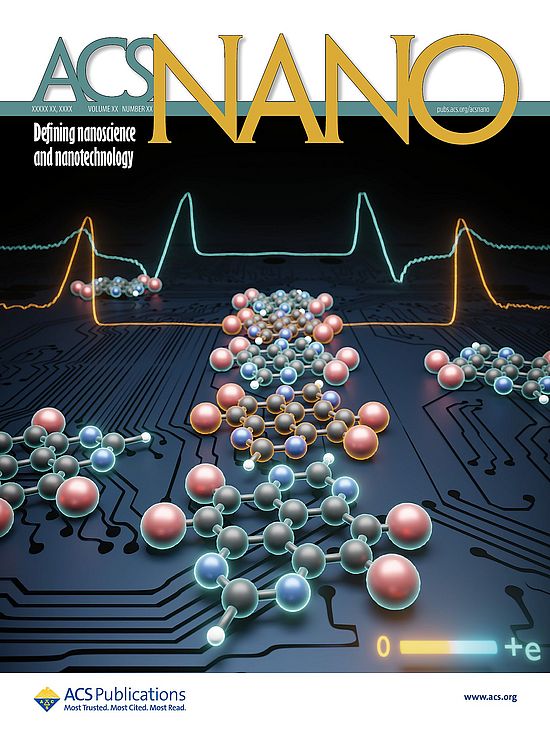
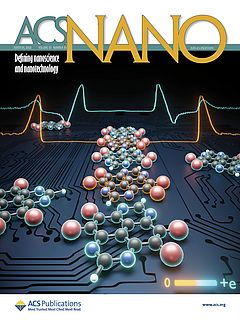
Understanding and controlling charge states at the level of individual electrons in molecular assemblies is often hindered by system complexity and the lack of reliable theoretical framework to accurately model the underlying many-body non-equilibrium electron dynamics. To address this challenge, here we construct well-defined molecular trimers and hexamers of tetrabromo-tetraazapyrene molecules by scanning probe manipulation and show that the electron dynamics can be completely rationalized using the Anderson impurity model and master equation approach. Our analysis demonstrates that such a treatment, which goes beyond the standard single-particle picture, is essential for understanding this class of molecular systems. The model not only quantitatively reproduces all features visible in measured differential conductance maps, but also uncovers the mechanism for negative differential conductance, which arises from the non-equilibrium occupancy of collective charge states. The analysis also reveals that the charging rings are not necessarily associated with changes in the total charge of the cluster, but often originate from internal charge rearrangements between the sites. These findings provide insight into fundamental quantum many-body effects in strongly interacting molecular systems and open pathways for engineering electronic phases by controlling cluster topology and the electrostatic environment.
Family of magnetic field-boosted superconductors in rhombohedral graphene

Superconductivity in rhombohedral multilayer graphene
In some unconventional superconductors, time-reversal symmetry can be broken apart from the gauge symmetry, resulting in superconductivity that can be enhanced or induced by magnetic fields. However, field-enhanced superconductors are more vulnerable to impurities than their Bardeen–Cooper–Schrieffer counterparts. Crystalline rhombohedral multilayer graphene is a promising platform to explore them because of its superior material quality and gate-tunable strong correlation effects. Here we report transport measurements of rhombohedral tetralayer and pentalayer graphene, demonstrating a spectrum of clean-limit superconductivities. We found three different types of field-enhanced and field-induced superconductivities in the pentalayer. They are all robust against an in-plane field up to 8.5T, exceeding the Pauli limit by tens of times. Compared with Bernal bilayer graphene showing only in-plane field-enhancement, pentalayer graphene features superconductors enhanced by out-of-plane as well as in-plane fields. They also reside at much lower gate electric fields owing to the intrinsically flatter band dispersion—facilitating their study and further engineering. Moreover, we observed that proximitized spin–orbit coupling generates multiple new superconductors without introducing additional disorder effects. Our work establishes a new family of magnetic field-boosted superconductors in rhombohedral graphene. Using the high accessibility with moderate gate voltages, this will pave the way for realizing non-Abelian quasiparticles through interfacial engineering in the extreme clean limit, in that proximitized spin–orbit coupling leads to topological states and maintains the ultrahigh quality of crystalline graphene.
Gate-tunable topological superconductivity in a supramolecular electron spin lattice

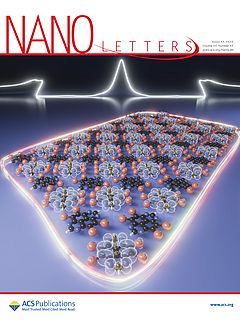
Low-dimensional magnet/superconductor hybrid systems have been proposed as a platform for achieving topological superconductivity. Here we showcase the supramolecular assembly of organic radicals directly on superconducting Pb(111), whose charge state can be controlled from anionic to neutral by the electric field of the scanning tunneling microscope. The anionic molecules obtained by an electron given by the substrate carry a spin-1/2 state and form a two-dimensional spin lattice, as confirmed by the observation of Yu–Shiba–Rusinov subgap states in tunneling spectra. At the boundary of the molecular domains, low-energy subgap states appear localized with high intensity at edges compared to the interior of the island. Tight-binding simulations suggest that their localization and spectral signatures are consistent with the emergence of topologically protected modes. Our results pave the way for the design of organic/superconductor hybrid systems with the potential to realize topological superconductivity.
Cascade C−H halogenation of tetraazapyrene with iodine halides

Iodine halide as an efficient and selective halogenation reagent is presented for the cascade halogenation of an electron-deficient tetraazapyrene (TAP), yielding both chlorinated and heterohalogenated derivatives. This approach enables precise control over the LUMO energy levels of the resulting TAPs by varying the type and extent of halogenation, offering a powerful strategy for fine-tuning their electronic properties. These findings open new avenues for the rational design of TAP-based materials in organic molecular electronics.
Discharge and electron correlation of radical molecules in a supramolecular assembly on superconducting Pb(111)

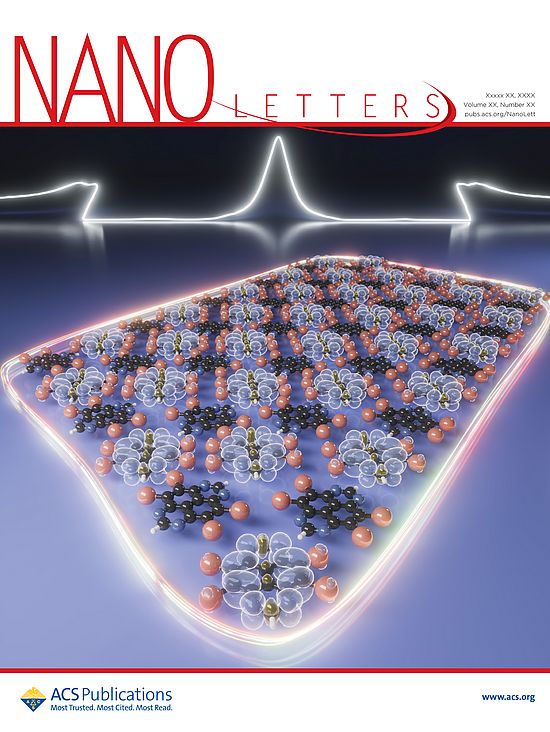
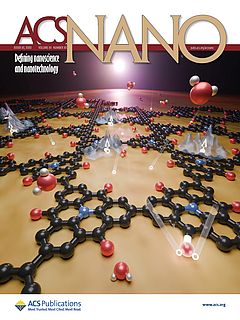
Electron spin lattices on superconductors offer a promising platform for quantum technologies. They can serve as qubits in quantum computing or provide a basis for exploring exotic quantum phases, such as spin liquids and topological superconductivity. However, constructing and scaling up these artificial lattices while maintaining precise gate tunability remains a significant experimental challenge. In our work, we demonstrate the supramolecular assembly of 4,5,9,10-tetrabromo-1,3,6,8tetraazapyrene (TBTAP) molecules on a superconducting Pb(111) surface, forming a compact electron (spin) superlattice consisting of coexisting neutral TBTAP and singly charged TBTAP species. Using tunneling and force spectroscopy, we identify the signature of a discharging event in the charged TBTAP molecules. This event is triggered by capacitive coupling between the molecular charge state and the local electric field from the STM/AFM tip, enabling a controlled transition from the anionic to the neutral state as a function of the applied tip voltage. Our results demonstrate a new pathway for the bottom-up construction of gatetunable, high-density spin networks, offering a powerful platform for investigating electron correlation effects and emergent quantum phenomena at the molecular scale.
Signatures of chiral superconductivity in rhombohedral graphene

Chiral superconductors are unconventional superconducting states that break time reversal symmetry spontaneously and typically feature Cooper pairing at non-zero angular momentum. Such states may host Majorana fermions and provide an important platform for topological physics research and fault-tolerant quantum computing. Despite intensive search, chiral superconductivity has remained elusive so far. Here we report the discovery of robust unconventional superconductivity in rhombohedral tetra- and penta-layer graphene in the absence of moiré superlattice effects. Spontaneous time-reversal-symmetry-breaking (TRSB) due to electron’s orbital motion is found, and several observations indicate the chiral nature of these superconducting states. Our observations establish a pure carbon material for the study of topological superconductivity, and pave the way to explore Majorana modes and topological quantum computing.
Long-range crossed Andreev reflection in a topological insulator nanowire proximitized by a superconductor

Crossed Andreev reflection is a non-local transport phenomenon that creates and detects Cooper pair correlations between distant locations. It is also the basis of Cooper pair splitting to generate remote entanglement. Although crossed Andreev reflection has been extensively studied in semiconductors proximity-coupled to a superconductor, observing it in a topological insulator has been very difficult. In this work, we report the observation of this effect in a proximitized topological insulator nanowire. We perform local and non-local conductance spectroscopy on mesoscopic devices in which superconducting niobium and metallic contacts are connected to a bulk-insulating nanowire. In our local conductance measurements we detect a hard gap and the appearance of Andreev bound states that can reach zero bias. We also occasionally observe a negative non-local conductance when sweeping the chemical potential, providing evidence of crossed Andreev reflection. This signal is detected even over length scales much longer than the expected superconducting coherence length of either niobium or the proximitized nanowire. We suggest that this long-range effect is due to the intricate role of disorder in proximitized nanowires.
Individual assembly of radical molecules on superconductors

Magnetic impurities on superconductors present a viable platform for building advanced applications in quantum technologies. In this work, we show the manipulation of magnetic states in the radical molecule 4,5,9,10-tetrabromo-1,3,6,8-tetraazapyrene on a Pb(111) superconducting surface using low-temperature scanning tunneling microscopy. Tunneling spectra reveal Yu-Shiba-Rusinov (YSR) states near the Fermi energy in isolated molecules. The presence of a second TBTAP molecule allows tuning of the YSR state position by altering the relative distance and can induce splitting of the YSR states for certain orientations. The construction of molecular chains up to pentamers shows periodic arrangements of charged and neutral molecules, with even-numbered chains forming a charged dimer structure at one end. Information can be encoded in these chains by switching the dimer position. These findings elucidate interactions between molecular assemblies and superconducting substrates, paving the way for advanced quantum-state engineering.
Spin excitations of high spin iron(II) in metal–organic chains on metal and superconductor

Using surface coordination chemistry with pyrene-4,5,9,10-tetraone (PTO) precursors as ligands, Jung-Ching Liu and coworkers have demonstrated the synthesis of an iron-based spin chain on Ag(111) and Pb(111). Low temperature tunneling spectroscopy (white spectrum) shows low-energy spin excitations (orange arrows) from coordinated Fe atoms with high S = 2 spin-state.
On-surface synthesis and characterization of radical spins in kagome graphene

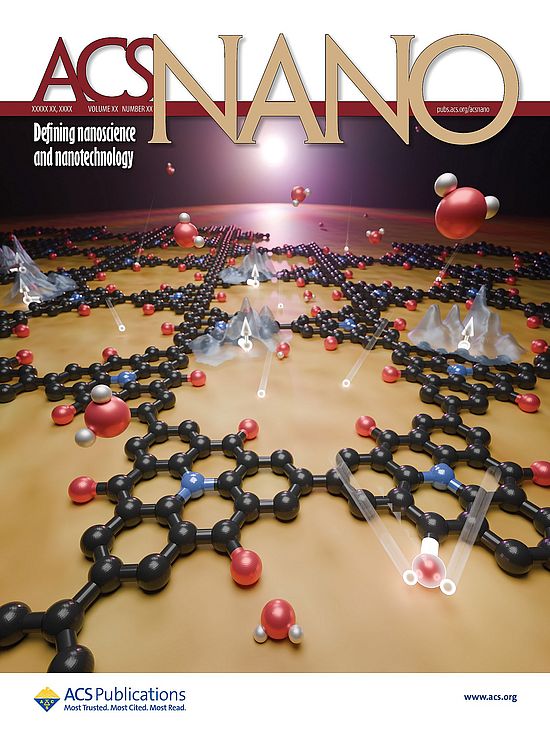
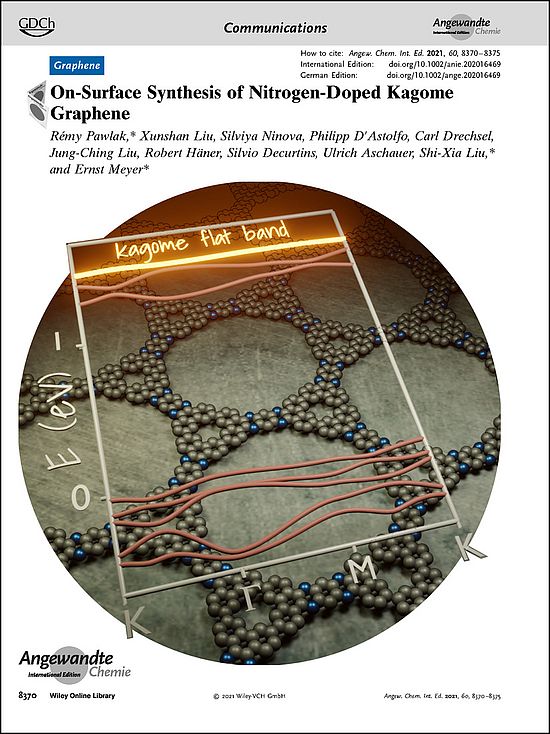
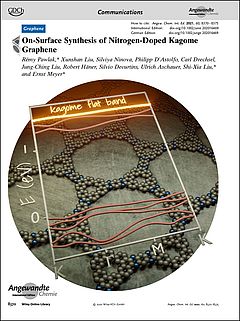
Flat bands in Kagome graphene might host strong electron correlations and frustrated magnetism upon electronic doping. However, the porous nature of Kagome graphene opens a semiconducting gap due to quantum confinement, preventing its fine-tuning by electrostatic gates. Here we induce zero-energy states into a semiconducting Kagome graphene by inserting π- radicals at selected locations. We utilize the on-surface reaction of tribromotrioxoazatriangulene molecules to synthesize carbonyl-functionalized Kagome graphene on Au(111), thereafter modified in situ by exposure to atomic hydrogen. Atomic force microscopy and tunneling spectroscopy unveil the stepwise chemical transformation of the carbonyl groups into radicals, which creates local magnetic defects of spin state S = 1/2 and zero-energy states as confirmed by density functional theory.